Showing posts with label Scripture. Show all posts

Tuesday, 27 October 2020

Reading Culture

I’m never quite sure whether to be astonished at how much of value survives from the ancient world, or regretful that there are so many things we don’t know. But all our descriptions of the ancient world, including the world(s) of the early Christians, are a mix of things we know, and our best (often very well educated) guesses. But there’s also an awful lot of knowledge that, frankly, is simply missing. 

A lot of that has to do with culture. It’s a slippery word and people write books trying to describe it, but one way to think of culture is “the things everyone knows but no-one bothers to explain”. 

Culture: the things everyone knows but no-one explains


A trivial example might help. When someone says “Can you pass the salt, please?”, we instinctively reach for the container with one hole in the lid. But almost certainly, someone describing the scene would simply say: “She passed the salt.” They would not think to write: “Emily looked at the table. There were two containers there. She knew which one was the salt even though they were made of metal she couldn’t see through, because salt containers typically have one hole in the lid, whereas pepper containers typically have several holes. English tables normally only have salt and pepper on them, and not other spices that can be shaken over the food.”

The lengthy informative description might help a future foreign historian, but no-one would think of writing it down. That’s also true of the biblical and other early Christian writers. They leave out the stuff that “everyone knows”. Trying to fill in the blanks by careful reading, profound study, and ingenious deduction is what keeps the ranks of scholars busy, as they agree and disagree with one another’s detective work.

Over the following days’ posts, I’m going to look briefly at three short descriptions of reading in the ancient world, noting a few features of the public reading described there. I shall take one from each of the Old and New Testaments, and one from a second century author. It both shows the deep and rooted nature of this ministry that people are still fulfilling in today’s church, and illustrates an issue all modern readers face – however well studied they are. 

We usually know enough to understand the main thrust, and often a great many details of what we’re reading. However, there’s always more we might discover, and there’s almost certainly some missing information we may never find. Anyone who feels they have to understand everything before they can read in public may well be waiting for ever.

Friday, 29 May 2020

Writing and reading

The books that go to make up the bible were written for reading aloud. This is generally true of books in the ancient world. There’s a story from St Augustine that underlines this point. He was a North African bishop in the late fourth and early fifth century, who was also one of the cleverest and well-educated men of his day. In his Confessions he thinks it worthy of comment that, Ambrose, bishop of Milan, always read silently. Reading aloud was the norm, even for the highly educated who read on their own.1

For most people, in a society where the majority could not read, the only way they encountered books at all, was through other people reading to them or for them. There are places where, in different ways, that practice shows through in the pages of the bible.

Paul’s first letter to the Thessalonians is commonly believed by scholars to be the first book of the New Testament to have been written, sometime around the year AD 50. As he comes to an end, Paul says: "Greet all the brothers and sisters with a holy kiss. I solemnly command you by the Lord that this letter be read to all of them. The grace of our Lord Jesus Christ be with you." (1 Thess 5:26-28)

Paul has written to and for “all the brothers and sisters” (his language for church members) and he wants them to hear his own words, not just a summary. It seems reasonable to deduce that he knows there is at least one person in the congregation in Thessalonica (modern Thessaloniki) who can read, but that many – most, if not nearly all – can’t.

Those who read the same books today in church settings are standing in a long line of people who are using them as they were originally intended to be used. They are texts written to be performed.

Today’s readers have some advantages over the readers of Paul’s day. First, they get to read a printed text, rather than a handwritten one. If I’d written this book, rather than typed it, dear reader, you wouldn’t have a chance; my handwriting is dreadful. All the books written in the first 1500 years of the church’s life were handwritten, and almost certainly not by the people we call their authors.

We tend to think of learning a single skill: reading-and-writing. It was not so in the past. Quite a few people who could read well – including the very highly educated – might only occasionally have bothered with the physical activity of writing. Writing was a different job, usually carried out by commercial writers or slaves. We meet some of the members of this group of specialist writers in the pages of the gospels as the “scribes” who sometimes dispute with Jesus. And we can see it operating in some passing references in Paul’s letters.

At the end of his first letter to the Corinthian church, he remarks: “I, Paul, write this greeting with my own hand.” (1 Cor 16:21) The rest of the letter, it seems, has been dictated to a proper writer. In another letter, Galatians, Paul appears at one point (at least) to take over the writing. It’s a letter in which he is especially emotional, so that probably explains why. He says: “See what large letters I make when I am writing in my own hand!” (Gal 6:11) Trained scribes learnt a professional way of writing. Large letters are the mark of an amateur writer, using up rather more of the quite expensive papyrus or parchment than they need to.
If this firm distinction between reading and writing seems strange, perhaps the best analogy is between a touch-typist and someone like me, who uses two (or at best four) fingers to type with. I don’t have the professional skill set, even though I think I’m reasonably well educated, and fluent in English.

There is a second advantage which readers have today. Our texts have all sorts of help available to the reader. First, we use a mix of upper- and lowercase letters. We start sentences with a capital letter, and also use capitals for names. In the ancient world, they only used capital letters. Then, we use spaces between words, and lots of punctuation. The ancients wrote a stream of continuous characters in capital letters, and the reader had to divide them into words and phrases as they went along. Imagine visiting a website called http://www.godisnowhere.com and working out whether it’s an atheist site (God is nowhere) or a believing one (God is now here). That sort of problem could crop up any time for the ancient reader. We also have other helps, like chapter and verse numbers, and often nowadays paragraph headings. All these have gradually been added over time.
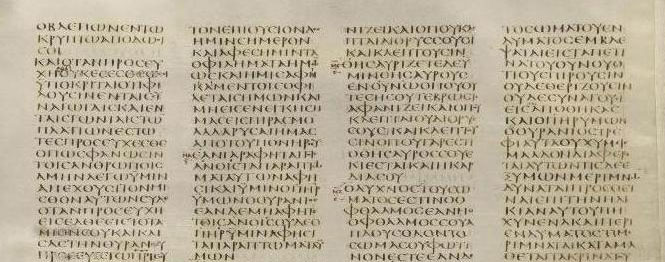

Codex Sinaiticus
Half a page (of Matthew 6) of Codex Sinaiticus, a 4th century bible with its own website

Despite all these difficulties, early Christianity was determinedly literary. Christians wrote books, lots of them, and expected other Christians to read them. Those books which ended up getting into the bible were simply the most important to the mainstream of the growing Jesus movement as that mainstream morphed into what became known as orthodox or catholic Christianity. Along the way, the early church popularised the use of books instead of scrolls. In choosing the medium of a book (properly called a codex), the early Christians made an impact on how writings were produced which has lasted to the present day. 

The writings we now have in the New Testament are just the tip of the iceberg; the early churches were very keen on making books. They told stories, offered instruction, shared visions and wrote letters. Yet even though the production of books was central to their shared life, most early Christians mainly experienced these books only as they were read aloud when they gathered. For the average church member, the scriptures (like all other literature) were books to listen to. They were not read in solitary quiet times, but in corporate worship and social learning.

Readers were vital to that experience, and those who read the bible today in church inherit a long and honourable tradition that has been at the heart of historic Christianity. Initially it was simply a function. It quickly became valued as a ministry.

Notes

  1. Augustine's description comes in Confessions 6:3 (e.g. as translated by Henry Chadwick, Oxford World Classics 1991 , p93)


Saturday, 16 May 2020

Reading Rite – an introduction

On sabbatical early in 2019 I was trying to write the first draft of what I hoped might be a simple introduction to the bible for those who have to read from it in public worship. As I worked, I came to realise that it would be too long to be the sort of book which might be attractive to the kind of audience I had in mind.

I put it away for a few months, but thought after I’d let the first draft settle a bit, perhaps the second draft might be a (long) series of blogs. Now it feels right to resurrect the idea, and so partly as the vehicle for this series, and partly for other posts on worship, prayer and liturgy, I launched a new site in autumn 2019.

Then I realised thatI wouldn't be purchasing that web domain in perpetuity. One solution is to back it up to Blogger, tidying up as I go along. Hence this site! The index page will lead you through it in "book" order i.e. the order it would be in if you were reading it as a conventional book.

Most introductions to the bible seem to be for those using it for personal, devotional study, or preparing to begin some kind of academic study course, perhaps training for some form of recognised ministry. None seem to me to focus on the needs of the person who has to read it in front of other people, perhaps with very little guidance on how to understand what they are reading.

This series will try to fill that gap. If you are asked, or if you volunteer, to “read the lesson” – as it used to be called – you are given an important responsibility: to read so that others can understand the meaning of the reading.

Your hearers may not grasp every significant detail, and you’re not there to put the preacher out of business. However, those who listen to you should get some idea that what they’re listening to makes sense; after the reading they should feel they have at least a broad grasp of what the Scripture means. The minimum requirement for that is for you, as the reader, to have some sense of the meaning of what you’re reading, so that you can convey it to others.

That’s not always as straightforward as most of us would like. While some of the most obscure and difficult passages in the bible aren’t normally included in those selected for Sunday readings, the books you read were written a long time ago, in very different cultures to our own. It would be surprising if they weren’t sometimes tricky to understand.

In this (to borrow a common description) “idiot’s guide”, I hope to give enough pointers to stand you in good stead for reading with understanding. You might, after reading this blog, find you want to engage in your own more detailed study, in which case one of those other books might provide a good sequel to this. But this may be all you want or need for now.

I’m going to use a metaphor from the world of technology to organise this book. The first section deals with the hardware: the story of how we got the bible, and the key role that public reading plays in that story.

The second section is about firmware: the pattern of readings and how they are organised for use in church. This section also includes the human interface, you, the reader. It deals with the actual practice of reading with a mix of hints, tips and practicalities about reading.

The third section will deal with software: the actual content of the books of the bible, and how we might approach reading from them. This final section is by far the longest section, and I will largely cover the contents of the bible book by book.

I hope you find it helpful.

Welcome to Lection and Liturgy

Welcome to Lection and Liturgy. I have backed up to this site a series of posts making a guide to the whole of the Christian Bible, aimed p...

Some frequently read posts