Showing posts with label Paul. Show all posts

Thursday, 31 December 2020

Negotiating the master-slave relationship in a church family: the letter to Philemon

Philemon is the shortest of all Paul’s letters. (That hasn’t stopped someone writing a 600 page commentary on its 25 verses!) In the Roman Catholic lectionary selected verses are read on the 23rd Sunday of Ordinary Time in Year C. The corresponding Proper 18 in the Revised Common Lectionary, as so often, lengthens the reading to almost the whole letter, leaving out only the closing greetings. 

While some of the precise details are obscure, the overall picture is generally agreed to be straightforward. Philemon seems to be a member of the church at Colossae, who found his Christian faith through Paul’s ministry. Onesimus is a runaway slave of Philemon who has ended up in Paul’s company, and been visiting him while Paul is under arrest. As a result of his contact with Paul, he has come to faith in Christ independently of the commitment made by his master.

Slavery was everywhere in the Roman world. Picture via Wikipedia (public domain)

According to their shared culture Paul owes Philemon the duty of returning his runaway (Philm 13-14). Equally, as another of Paul’s converts, Philemon owes Paul his gratitude for receiving the gift of Christ through his preaching (Philm 17-19). Paul is therefore sending Onesimus back, with the letter for the church at Colossae (Col 4:9) to which Philemon belongs. 

The letter is very carefully crafted to discharge Paul’s social obligations to Philemon in sending Onesimus back, while persuading Philemon to discharge his spiritual and moral obligations to Paul by setting Onesimus free. As a whole the letter forms an important counterbalance to those passages elsewhere which show Paul accepting the practice of slavery without much protest. It is also an illuminating window into how the language of reciprocal gift and obligation works in an individual relationship.

This is one of those occasions I would encourage the reader to ask the preacher how they are going to pronounce the names in the letter. Traditional English pronunciation has said something like Fye-lee-mon and Oh-ness-i-muss. Other people base their pronunciation on the Greek stresses, more like Feel-ay-mon and Oh-nay-see-moss. (the bold syllables indicate the stresses). It’s not that one is right and the other wrong, just that it might be helpful in a letter in which the people are so much the heart of the argument, if both reader and preacher use the same pronunciation of the name.

(For further general guidance on pronunciation of difficult names, see this post.)

House rules and cultural accommodation: the Pastoral letters

Icon of St Timothy. Via Wikimedia Commons.

The Sunday lectionary reads selections from 1 & 2 Timothy through in sequence towards the end of Year C,1 and uses a couple of short excerpts from Titus in the selections for Christmas Day. As I noted in my introduction to Paul’s letters, these three are sufficiently like each other to be grouped together, and sufficiently different from Paul’s other letters for many people to wonder if he wrote them. Although they are usually called, collectively, the Pastoral Letters, I think they might better be thought of as “organisational letters” written for those who have some responsibility for organising the church.

Whether Paul did write them, directly, indirectly or not at all, they are in any case different in form. They are not letters to churches, but letters from a senior to a junior colleague. If Paul (as the letters say) calls Timothy and Titus his “sons” in the faith, we should remember that was not simply a relationship of affection, but one in which the father could lay claim to the obedience of the son, and direct him how to carry out his life and work. That alone would be enough to give them a very particular tone.

In the presumed relationship between Paul and these two “sons”, we also see something of the way in which the church comes to structure itself. The offices of bishop and deacon, which first appear at Philippi (Phil 1:1) now seem to be becoming more widespread as terms for leaders (1 Tim 3:1-13). The family relationships that Paul claims for himself, and Timothy and Titus as his household, also become a model for church leadership, and a means of discerning the calling to it: “if someone does not know how to manage his own household, how can he take care of God’s church?” (1 Tim 3:5).

The place of women in the church seems to be taking a further step backwards even from the situation in Colossians and Ephesians. First Timothy in particular seems to take a very big step away from Paul’s acceptance of women as colleagues. There is unfortunately insufficient context to help us understand if a very particular problem is being addressed, or if this apparent change in the status of women in the church is a good reason for doubting these letters come in any straightforward way from Paul’s pen.2

Bishops and deacons, and the letters still seem to expect women to be counted among the deacons (1 Tim 3:11), seem to exist as groups sharing leadership rather than isolated individual ministers. Elders (Tit 1:5) and bishops (Tit 1:7) seem to be interchangeable titles. The idea of a single bishop in a place doesn’t seem to really arrive until St Ignatius of Antioch at the beginning of the second century. However, Timothy and Titus do, rather like Paul, operate much more as individual leaders – much more like later monarchical bishops – even if they have collegial groups to work with. Whereas First Timothy and Titus address the role of each as church organiser, Second Timothy concentrates on Timothy’s role as a teacher, continuing Paul’s work of passing on the nascent Christian tradition (2 Tim 2:2; 2:24-25; 3:14-4:5).

If the previous section on the Thessalonian letters showed us a church carried away with enthusiasm for the end of the world, these three letters show it dug in for the long haul. They form an early version of handbooks for managing the pastoral care of the church, and legislating practically for a church that isn’t yet organised by law and custom.

Some of the trajectories which will lead to the more fully developed church of the second century are now plainly visible, and this strange mix of radicalism and conservatism will continue to interact with each other in the history of the church. There is always a tension between passing on the faith and teaching of the gospel, and seeking to adapt the life and understanding of the church appropriately to the world in which it does so.

Notes

  1. Propers 19 – 25, 24th – 30th Sundays in Ordinary Time.

  2. The most problematic verses (1 Tim 2:12-15) also bristle with translation issues: does the writer forbid women to have authority over men, or forbid wives from bossing their husbands about? Does he say women’s salvation depends on having children, or that women will be kept safe through childbirth if they live appropriately obedient lives? It is these kinds of questions that help stir the pot about whether Paul could possibly have written such verses. Fortunately, these verses need not trouble readers of the Sunday lectionary, as they are (quite wisely!) not used.

It’s the end of the world as we know it: the Thessalonian letters

I take both the letters to the church at Thessalonica together. Between them they have no more lectionary readings than the individual letters we have already looked at, and they cover much the same territory. Their key theme is how to live when you are expecting the end of the world as you know it. While living in expectation of Christ’s appearing remains a significant theme in Paul’s letters, it is at its most intense here. It also seems to be an expectation that is not fully understood by his Gentile converts in Thessalonica, who lack the grounding in Old Testament texts to fully appreciate it. Unsurprisingly, given this emphasis, the majority of readings from these letters comes in the Advent season.

These letters were (at least if they are both by Paul) probably written fairly closely together. According to Acts, Paul visited Thessalonica early on his second missionary journey (Acts 17), and these letters seem to have been written fairly soon after that, making First Thessalonians perhaps his earliest letter. According to the account in Acts, his exit was a matter of rather hasty necessity in the face of Jewish mob violence: perhaps that explains why he is so anxious about how things have gone on since his departure.

Roman Thessalonica’s forum, with modern Thessaloniki behind it. Via Wikimedia Commons.

The opening half of First Thessalonians show something of his anxiety that things there went almost too well. Would the Thessalonian Christians persevere in their faith (which in characteristically Jewish fashion Paul describes as having “turned to God from idols, to serve a living and true God (1 Thess 1:9),” or return to their previous existence? Paul shows himself unusually apprehensive about the outcome of his ministry. He rehearses his relationship with them, stressing his ethical qualifications as evidence of his care for them. And because he was so anxious that he might have failed, he sent Timothy to them, and is now exultant and thankful, because Timothy has returned with the news that the Thessalonian church is largely a success story.

From the beginning of the letter, Paul has characterised Christian existence as “waiting for God’s Son from heaven”. In the later chapters he encourages them to live as those who at any moment might find Christ arriving, in an image from Jesus’ teaching, “like a thief in the night” (1 Thess 5:2). He uses an earlier version of his imperial metaphor about Christ’s return.1 Just as the emperor or his representative might arrive with an entourage, and people from the city would go out to greet him, so Christ will return to earth accompanied by those saints who have died, and those Christians still living will start to journey into the sky to meet them.

This metaphor only works with a fairly literal model of three tier universe, which is not our model. But Paul is less interested in the mechanics, than in assuring the Thessalonians that those who have died will also – and indeed before those who have not – experience the resurrection. Being raised with Christ did not mean they would not die, but that they were given an inalienable promise of life in Christ’s new age.

Second Thessalonians suggests that Paul has become rather more worried by strange beliefs circulating in Thessalonica about Jesus’ final appearing. He unusually stresses the place of God’s judgment on those who do not acknowledge God (2 Thess 1:8-9). But he appears to have two main concerns. The first is one Jesus warns about in the gospel traditions, that some people will claim Jesus’ appearance is happening when it is not (2 Thess 2, and compare e.g. Matt 24:22-27).

The second concern picks up something only hinted at in his first letter to them: the importance of working and not being idle (1 Thess 4:11-12; 2 Thess 3:7-12). Historically, most Christians seem to have read this as assuming that the Thessalonian expectation of Jesus’ imminent return was so strong, and their timetable for it was so short, that they had simply downed tools, and were not expecting any need to provide for the future.

A more recent view I find attractive is that, as poorer members of the church had been given access to a new network of patrons, they were putting their energy into promoting their new patrons’ business in return for the basics of living.2 Either way, Paul expects his Christians to get on with the business of living out their faith in the real world, in a way that may also allow them to contribute to the needs of others as well as support themselves.

Notes

  1. See my earlier post on Philippians.

  2. As far as I am aware, a version of this view was first put forward by Bruce Winter “‘if a man does not wish to work…’, a cultural and historical setting for 2 Thessalonians 3:6-16” Tyndale Bulletin 40.2 (1989) pp 303-315

King of the universe: Colossians

A small number of passages from Colossians crop up several times over the course of the lectionary. Selections from the letter are read through in the earlier summer weeks of post-Easter Ordinary Time, in Year C. The hymnic passage extolling Christ as the centre of both creation and its restoration as new creation (Col 1:15-20) is also read on Christ the King (again Year C). And the opening of chapter 3 is also read on Easter Day (Year A).

The letter as a whole reads a little like a first rehearsal for some of the themes we have seen developed in Ephesians. The story of human redemption is told on the same cosmic scale. In his description of Christ as “the image of the invisible God”, Paul seems to be echoing Wisdom chapter 7, especially verses 23-27. If Jewish thinkers increasingly saw Torah as the repository of divine wisdom, Paul leads the way for Christian thinkers in seeing Christ as wisdom’s true incarnation, a theme that is developed in John’s gospel.

The Arch of Titus (built by Domitian) is inscribed with images of the triumph enjoyed by the Emperor Vespasian and his son Titus after the Jewish War and the fall of Jerusalem.

There is another example of the appropriation of imperial imagery in Paul’s description of the cross.1 It is compared to a Roman triumph, rather than the absolute defeat it looked like. In a triumph, the victorious general in the days of the Republic, was granted the opportunity to parade into Rome. The Emperor took this over for himself. The victory parade was accompanied by various specimens of those he had defeated, now shown as humiliated captives, often naked, put on show for public entertainment. This, Paul says, is what the cross does to the spiritual forces that thought they had wrested the universe from God’s control: “he has stripped the sovereignties and the ruling forces, and paraded them in public, behind him in his triumphal procession” (Col 2:15 NJB)

Paul, like the church after him, has a sometimes ambivalent view of power. And again, as in Ephesians,2 we see some of the accommodation to the social expectations of Roman patriarchy in the unequal advice given to husbands, fathers, and masters on the one hand, and wives, children and slaves on the other (Col 3:18 – 4:1). While Paul is, by first century lights, quite demanding in his expectations of how the first group should behave, he nonetheless supports their respective superiority over the second group. The seeds of an imperial church, even if it is unimaginable at this point in time, can nonetheless with the benefits of hindsight, be seen in outline as the first-century church develops.3

Nonetheless, the life of the church lived under the rule of Christ should reflect the life of heaven in which it participates (Col 3:1-4) In particular, it needs to be marked with forgiveness, humility and kindness, dressed in all the virtues, marked especially by love, and living in peaceful harmony (Col 3:12-17). Once again, the theme of living in unity emerges in Paul’s thought as its strongest ethical note. One question the church always has to wrestle with, though, is whether particular vulnerable groups are being asked to pay the price for that unity by submitting to the decisions of more powerful ones.

Notes

  1. See the previous discussion of Roman metaphors in Philippians.

  2. See the post on Ephesians

  3. I said more about this in the previous post on Philippians. Perhaps one of the reasons some people prefer to assign both Colossians and Ephesians to a later Pauline disciple is because they want to dissociate their hero Paul from this kind of thinking.

Colonies of heaven: Christianity as a Roman religion in Philippians

Christianity might have been born in a thoroughly Jewish home, but it quickly got sent to a Roman boarding school. In Paul’s letter to the church at Philippi, we see something of that happening. Philippi, like Corinth was a Roman colony, and Paul draws rather more positively on that heritage to shape his language when he writes to the Philippians, than he does in his more troubled relationship with Corinth. Indeed, it may well have been the Philippian church Paul had in mind when he spoke of the generosity of the Macedonian churches (2 Corinthians 8:1-7), appealing to the competitive spirit at Corinth, and trying to get them to up their game in the generosity stakes.

Paul envisages in Philippians that his death might be a very real possible outcome of his imprisonment. The picture is the traditional site of Paul’s burial in Rome.

Certainly there is a strong note of thanks in the letter, not least for the practical help the Philippians have sent Paul via Epaphroditus (Phil 2:25; 4:18). This practical, probably financial, help also appears to be included in what he means by their “sharing in the gospel” (Phil 1:5) He returns at the end to more thanks for their support even in the earliest days of his mission (Phil 4:15-19).

At Corinth he turned down financial support, fearful of being tied to the richer factions of the church (1 Cor 9:3-18). From the Philippians he accepted it, and saw it as more than enough to reciprocate what God had given them through his ministry. It is in reciprocal gift-giving that both divine and human relationships are created and sustained. In this letter, we see Paul making much of that.

Much of the letter is read in the Sunday lectionary, especially in Year A, yet if gratitude expressed in thanksgiving and joy provides the frame for the letter, and the subject of some of those readings, there are still problems Paul needs to address. One of those problems seems to be coming from outside the church, from those who continue to commend Torah observance (Phil 3).

Whether that is a serious problem at Philippi, or whether Paul has it on his mind because of dealing with it elsewhere is unclear. Combatting such views allows him to rehearse his characteristic themes of Christ as the model of faithfulness (Phil 2:6-11), of the overwhelming value of God’s gift in Christ devaluing by comparison all human achievement (Phil 3:2-10), and of the transformation of our physical reality by the coming of Christ (Phil 3:17-21).

One difference in the way he addresses this future transformation seems to be occasioned by Philippi’s status as a Roman colony, refounded by Augustus Caesar after his defeat of Mark Anthony at the battle of Actium some 90 or so years before Paul writes. It may be that he shows off a little bit to this pro-Roman city, that through his imprisonment (probably in Rome towards the end of his life) his message is known both to the imperial guard (Phil 1:13) and to the imperial civil service, where he has made converts (Phil 4:22)1

The most significant use Paul makes of this Roman context (his imprisonment and the Philippian heritage) is, however, the metaphor he picks to describe the future appearance of Christ. Augustus had appropriated the title Saviour of the World for himself as emperor, and Paul and other early Christians applied it to Jesus. It has always been political as well as religious language. Moreover, in theory at least, if a Roman colony was beleaguered, it could expect the army to come to its rescue. Paul now uses that imagery to talk about what we typically call “the second coming” but the New Testament tends simply to speak of as the arrival or presence of Christ.2

If the point of a Roman colony was to have Roman citizens staking Rome’s claim to a foreign land, Paul’s use of this language portrays the church as heavenly citizens staking God’s claim to a presently alienated world. And if they are beleaguered by this world’s powers, the true Saviour of the world is coming from the heart of God’s heavenly realm to their rescue. (Phil 3:20-21) Paul is quite comfortable in appropriating imperial language for Christ, as for God. It is one of the early steps that made it easier later on for Christian emperors to borrow religious language in turn for their own purposes.

As always, Paul also wants to urge unity on all his churches. One practical reason, and perhaps the dominant one for this letter, is that, as so often, Paul has to respond to a divided church, urging them to have one mind, and reject the all-too-Roman pattern of competition. It is in this context he produces one of his most famous passages, the poem-like verses celebrating Christ as the exemplar of putting God and others before oneself in faithful and humble service (Phil 2:6-11).

He returns near the end of the letter to what may be the heart of the dissension, an argument between two leading women in the church, Euodia and Syntyche (Phil 4:2-3). It is worth noting that he asks someone else to help them reconcile, rather than giving orders. That may reflect that they are high status in both society and the church: another example of women in leadership in the earliest churches. Paul certainly seems to want to get to this important point in a fairly roundabout way. The importance of unity, whether for quarrelling individuals, or for the whole church, is never far from Paul’s mind.

Notes

  1. The phrase Paul uses, “the household of Caesar” has, particularly since the ground-breaking work of Wayne Meeks (The First Urban Christians New Haven and London: Yale University and Press, 1983) been regularly seen as referring not to literal relatives of the emperor, but to the extended family of slaves and freedmen, whom Augustus and especially his successors, used to carry out imperial business.

  2. The word “presence” (Greek parousia) is probably not a technical term at this early stage: even in Philippians Paul simply uses the same word to mean his own presence again with the Philippians (Phil 1:26; 2:12).

A bold vision of a cosmic church: Ephesians

When we turn from Galatians to Ephesians, the change of tone is startling. This is one of those letters where the tone is rather less argumentative as well as less specific than Paul normally is. For many scholars, that suggests a disciple of Paul summarising some key elements of his master’s teaching. For others, it represents simply a different scribe, and Paul in a more reflective and different mode of teaching. The letter certainly shares Paul’s love of long and convoluted sentences, with Eph 1:3-14 essentially being a single sentence in the original Greek (depending on your view of what a sentence is!).

Extracts from Ephesians are mainly read in the summer months in Year B. It also provides a number of epistles for saints’ days. As I say, it seems less specific than many of Paul’s letters, which is a reason some people raise questions about how closely it is connected with Paul himself. Indeed, some of the best and earliest manuscripts don’t actually have a destination: the words “in Ephesus” (Eph 1:1) may well be a later addition to the text. This would further add to the sense of a more general letter. For some that is another reason for questioning how it relates to Paul, for others that is further explanation for why Paul adopted a different writing style. 

The ruins of the theatre at Ephesus. The second tier was added in Paul’s day,
the third tier rather later. Via Wikimedia Commons

Two key emphases in this letter, which seem to develop Paul’s earlier thought, are on the cosmic dimensions of faith and the placing of the church at the heart of the gospel. The union of Jew and Gentile in a single body of Christ, a single humanity in Christ, at the heart of a restored and harmonious creation, is presented as the eternal plan and purpose God has been working towards, even from before he created the world.

The nuts and bolts of that idea are scattered throughout Paul’s earlier writing, but here they are drawn together more boldly. The first three chapters riff on this theme of the mystery of Christ as God’s means to bring about the unity and harmony of the cosmos, with humanity restored in Christ – the church – as the centrepiece of a renewed creation.

The next three chapters (which make up the second half of this letter) bring this vision rather more down to earth. Paul reprises his themes on the unity of the church, with the differing gifts God has given it needing to work together in one body. In 1 Corinthians and Romans, those gifts were mainly conceived as abilities, talents that people brought to the common life. Here, however, they are the different ministers or ministries, which God has given to the church, so that all God’s people can serve him as they grow in mature faith (Eph 4:11-13). There are still plenty of imperfections that need to be addressed, and Christian need to live out in practice the life to which they are called, and continually renounce unethical behaviour.

Towards the end, the letter seems to take a step back from some of Paul’s earlier positions, in a passage not used in the Sunday lectionary. Although the writer puts some stress on the need for husbands to love their wives, fathers not to wind up their children, and masters to treat their slaves well, he nonetheless upholds the basic structures of a patriarchal and authoritarian society. Wives are expected to submit to husbands, children to obey fathers, and slaves give their masters the respect and obedience they owe to Christ. It seems a long way from some of the more radical statements we find elsewhere in Paul, and rather disappointing as a corollary to the lofty vision set out in the first three chapters of this letter.

The church, it seems, needed in the first century, as much as it has done in any other, to make compromises and accommodations with the surrounding society in order to make its message able to be heard. Perhaps the real spiritual battle, with which the letter finishes in fine metaphorical form, is to continue to work out how the vision of God’s purposes needs to be reimagined in every culture. Which compromises are necessary to gain a hearing, and which end up so changing the message that it ceases to be good news from God? There is much prayerful work to be done, in discerning how to translate the faith for every context. 

Constantly ask God’s help in prayer, and pray always in the power of the Spirit. To this end keep watch and persevere, always interceding for all God’s people. Pray also for me, that I may be granted the right words when I speak, and may boldly and freely make known the hidden purpose of the gospel. (Ephesians 6:18-19 REB)

Paul’s angriest letter: Galatians

Galatians, selections of which are read in the early Sundays of Ordinary Time after Eastertide in Year C, reads like Paul’s hastiest and angriest letter. He addresses the recipients as “foolish Galatians!” (Gal 3.1) And the letter includes one of his rudest comments, carefully left out of the lectionary, “Those agitators [arguing for circumcision] had better go the whole way and make eunuchs of themselves!” (Gal 5:12 REB) Paul’s passion and anger revolve around the subjects of circumcision especially, but also sharing a common meal.

A statue of Paul with a sword (symbolising the word of God) seems particularly appropriate
for this fiery letter. The statue is in St Paul’s Outside the Walls, Rome.

From the time of the Maccabean crisis1 circumcision and food laws had become key “works of the law” that helped maintain cultural boundaries around Judaism. Paul’s practice, of not requiring Gentile circumcision, and of sharing a common meal with non-Torah-observant Christians, was knocking that carefully maintained fence down again. As in Maccabean times, this produced a “zealous” reaction.

Paul himself was provoked to what he called zeal (Phil 3:6) which he demonstrated by persecuting the church. The people trying to enforce Gentile circumcision in Galatia may actually be less zealous than Paul had been, trying to change the church to their way of thinking rather than persecuting it. Paul, however much his views have been turned through 180°, is still the character who passionately believes his own views are the right ones, and will not easily accept disagreement with his deeply held convictions.

If First Corinthians showed us Paul at his most traditional and ecclesiastical2, Galatians shows us Paul at his most isolated and radical. He puts his understanding of Christ’s commission to him above everything else, and that understanding includes a full acceptance of Gentiles without demanding Torah observance. In Acts, Peter is shown as the first to reach that position (Acts 10), and in chapter 2 of this letter Paul himself tells the story of Peter being happy to share the common Christian meal with Gentiles at Antioch. In Paul’s version, however, Peter (along with Paul’s long-time companion Barnabas) stops doing this because they are afraid of some messengers from James practicing a Torah-observant Christianity. Peter might well have said that like Paul he was trying to be “all things to all people” (1 Cor 9:22) but Paul sees this as a compromise too far.

Paul retells this story of Peter to show that he, Paul, will even stand up to the chief apostle, and so he will certainly stand up to those who are stirring up trouble in Galatia. He is quite clear that the right of Gentile entry to the church is based on the gift of Christ, not on the gift of Torah. So, he asks them, in what he clearly believes is a knock-down argument, did they receive the Spirit, the gift of God’s presence and power, by keeping Torah or by the hearing Paul’s proclamation and believing it. (Gal 3:2)

Abraham, as in Romans, stands in for a prime example of faithful obedience, but more than this, the promise given to Abraham was that through him all nations would be blessed (Gal 3:8). This is the promise that is now fulfilled in Christ, Abraham’s true descendant. The law did not exist when this promise was made, and so can’t alter the promise. The promise comes to those who, like Abraham, receive God’s gift in faithful obedience.

In contrasting the old and new covenants, Paul uses the language of flesh and spirit in quite a few places, but especially in the closing ethical sections of this letter, where he contrasts the works of flesh with the fruit of the spirit. The idea of “flesh” is often misunderstood. In Paul, the contrast is rooted in the covenants. The first is made, quite literally, in the flesh, as knife is applied to foreskin. The second, that comes through hearing and trusting the story of Christ, is sealed with the gift of the Spirit.

From this Paul seems to generalise to “flesh” meaning everything that is not shaped by, given by, energised by the Spirit of God. Sometimes flesh is a relatively neutral word, sometimes quite a negative one. What it does not mean, however, is sexuality, and the sins associated with it. That should be obvious from Paul’s list of works of the flesh (Gal 5:19-21), which includes envy, ambition and quarrelling as well as fornication, indecency and debauchery. But “sins of the flesh” has acquired a life of its own in the English language which obscures Paul’s original meaning, and a reader needs to guard against that interpretation if they can.3

In the end, with Paul, we need to concentrate on the “fruit of the Spirit” (Gal 5:22-25) and give more attention to our own conduct than censuring that of others (Gal 6:4)

Notes

  1. See the post on 1 & 2 Maccabees.
  2. See this post on 1 Corinthians
  3. The relevant passage is read as Year C, Proper 8, 13th Sunday in Ordinary Time.

Wednesday, 30 December 2020

Keeping up with the Corinthians: a second letter to Corinth

Paul wrote more than two letters to the Corinthians: it’s the only way of making sense of the letters he mentions in his correspondence with them. It’s just that we don’t have any more than two collected in our scriptures, and don’t know what happened to the other(s). We have no way of knowing exactly how many there were. Some scholars, observing that the letter in the Bible called Second Corinthians seems a bit of a patchwork, suggest that it could have been stitched together from at least two, and perhaps three original letters.

There’s no real evidence to say so. The changes of mood and direction could just as well come down to getting interrupted mid-dictation by some event or news which caused a swerve in the argument. Since no-one has ever found a fragment of manuscript that shows a version of the letter with a different beginning, middle or ending, I think I prefer the simplicity of an interruption causing Paul to alter course. Either way, it’s a reminder that there are simply gaps in our knowledge, and not everything Paul wrote ended up as scripture.

Corinth and the Gulf of Corinth: a reminder it was a busy maritime city. Via Wikimedia

Selections from Paul’s second letter to Corinth are mainly read through in Year B following Eastertide. These are the 8 Sundays running from the 7th to the 14th Sunday in Ordinary Time.1 These are readings that tend to focus on Paul’s understanding of his apostolic ministry. Only on occasion does it become apparent that he is chiding the Corinthians for their behaviour. If you are reading from it in public worship, you should bear in mind that the main purpose of the letter is repair the breach between Paul and the Corinthians after they took his previous reprimands badly, while still reminding them of what they need to change. Ideally that will help you find an appropriate tone.

One thing that has changed since he wrote 1 Corinthians, is that the competition in Corinth has increased. There are more people, saying ever more strongly, that Paul is claiming an authority he shouldn’t have. These “super-apostles” (2 Cor 11:5) seem also to be arguing for a greater importance for Torah than Paul allows.

At the same time, Paul continues to teach the Corinthians many of the same themes as before. His ministry is marked by the pattern of the cross: his sufferings are borne in service to the Corinthians. His humility is patterned on the crucified Lord. Life in the present is to be marked by the hope and expectation of resurrection. “We look not at what can be seen but at what cannot be seen; for what can be seen is temporary, but what cannot be seen is eternal.” (2 Cor 4:18)2 Paul combines this with the great exchange he focused so much on in Romans. “For you know the generous act of our Lord Jesus Christ, that though he was rich, yet for your sakes he became poor, so that by his poverty you might become rich.” (2 Cor 8:9)3

Those who truly appreciate the divine gift will reciprocate not only in obedience to God, but also in generosity to others. The collection, which he mentioned at the end of his first letter to them, now assumes a more central position. Their generosity, he complains, has fallen well short of an appropriate response to Christ’s generosity. It has not (Paul rather naughtily appeals to the competitive instincts he normally combats) even matched the generosity of their poorer Macedonian neighbours and rivals (2 Cor 9:1-5).

Paul also writes this letter in a spirit of reconciliation. A previous letter, where his tone was too strong, seems to have damaged their relationship (and perhaps made room for the super-apostles to denigrate him). He is seeking to repair the breach, and also presents his whole ministry as one of reconciliation: as an apostle he is an instrument of God’s reconciling work. His appeal, like his pattern of ministry, is based on this: God’s great exchange in Christ: “Christ was innocent of sin, and yet for our sake God made him one with human sinfulness, so that in him we might be made one with the righteousness of God (2 Cor 5:21 REB).”4

Yet in competing with the super-apostles, his tone is as angry as it ever gets. Perhaps one of the reasons he so often reminds others, and particularly the Corinthians, of the need to pattern oneself on the humble service of Christ, is that like most preachers, he needs to preach it to himself. In something of a parody of boasting, he lists all the humiliations he has suffered as an apostle (2 Cor 11:23-33), yet there is a deadly serious and equally competitive point underlying it: “Are they ministers of Christ? I am talking like a madman—I am a better one (2 Cor 11:23).”

It is not at all clear how the message of the super-apostles differed from what Paul preached: he clearly feels that both his message and his authority (and they are hard to separate) are being threatened. An angry Paul is not always the most attractive Paul, and the lectionary tends to edit this side of him out. He certainly believes what he is defending is the gospel, and says fiercely that how people treat him is unimportant. However, he is as human as the rest of us, and sometimes seems to take a slight against himself as an attack on the gospel he preaches. The lectionary gives us the most acceptable verses from the closing polemical chapters,5 which are also a fitting summary of Paul’s complexity:

“Three times I appealed to the Lord about [my thorn in the flesh], that it would leave me, but he said to me, “My grace is sufficient for you, for power is made perfect in weakness.” So, I will boast all the more gladly of my weaknesses, so that the power of Christ may dwell in me. Therefore I am content with weaknesses, insults, hardships, persecutions, and calamities for the sake of Christ; for whenever I am weak, then I am strong.” (2 Cor 12:8-10 NRSV)

Notes

  1. The 7th Sunday in Ordinary Time is a week that can disappear as Easter shifts around.

  2. Proper 5, 10th Sunday in Ordinary Time

  3. 13th Sunday in Ordinary Time, Proper 8

  4. Set for Lent 4, Year C, and therefore often not read by Anglicans who tend to go overboard on Mothering Sunday.

  5. Proper 9, 14th Sunday in Ordinary Time – the Lectionary for Mass leaves most of the polemic out, the ecumenical lectionary, as so often, lengthens the reading to bring some of it back in. The passage quoted is in both versions.

When the church doesn’t do “Christian”: pastoral care case by case in First Corinthians

From looking at Paul’s most carefully and tightly argued letter, we turn to one that is almost a ragbag of collected problems, First Corinthians. These problems are either ones that the Corinthians have written to Paul about, or ones he has heard of from others. Here, even more than usual, we are aware as readers that we only have half a conversation.

The lectionary leaves out most of the passages in the middle of the letter where Paul is seeking to legislate for the community: issues of incest (ch. 5), settling community disputes (ch 6), provisions for marriage, celibacy and divorce (ch 7), and eating food offered to idols (ch 8). One of the losses in this is that we miss the details of how an early (probably largely Gentile) Christian church faces the problems of reimagining Jewish community organization.

What happens when you transplant Jewish tradition into Greek soil without the framework of Torah to shape it? What does following the example of the rural Palestinian Jew Jesus look like for an urban Greek coming from traditional Greek or Roman religion and culture? These questions lie behind the whole of the letter, but are particularly acute in the disputes the lectionary omits.

Roman Corinth’s Fountain of Peirene. Via Wikimedia Commons

Unlike most of us who preach and teach today, aware of our own failings, Paul (never a modest man) is confident in putting himself forward as an example: “To Jews I behaved like a Jew, to win Jews; that is, to win those under the law I behaved as if under the law, though not myself subject to the law. 21 To win those outside that law, I behaved as if outside the law, though not myself outside God’s law, but subject to the law of Christ. 22 To the weak I became weak, to win the weak. To them all I have become everything in turn, so that in one way or another I may save some.” (1 Cor 9:20-22 REB). People looking to imitate Paul must sometimes have got mightily confused about which Paul they were meant to be imitating.

Another significant feature of 1 Corinthians is that it shows us a far more traditional Paul than his other letters do. Paul is often presented – and sometimes presents himself – as a lone radical challenging the more conventional church of Peter and James. Here he is concerned to show he is of one mind with the whole church. He is a fellow worker with Peter, called by his Aramaic nickname Cephas,1 and Apollos (1 Cor 3). Paul quotes gospel tradition at least three times: on divorce (1 Cor 7:10 see e.g. Mark 10:1-12), on the mission of the disciples (1 Cor 9:14 see Luke 10:7) and on the institution of the Eucharist (1 Cor 11:23-26 see Luke 22:17-20).2

Paul also roots his exposition of the resurrection in chapter 15 in one of the earliest creeds, summarizing also the testimony of others to the resurrection (1 Cor 15:3-7), before appending his own. Finally, at a point where he suspects he is losing the argument about how women should dress and style their hair while praying, he appeals to the universal (he claims) practice of the church, the first known example of what is now called the sensus fidelium – the “sense of the faithful”. You can almost hear the exasperation as he exclaims: “But if someone wants to argue about this, we don’t have such a custom, nor do God’s churches” (1 Cor 11:16 CEB).

The sections of the letter that are used the most in the lectionary are chapters 1, 12 and 15. We will look at those in a moment after a glance at the most famous chapter, his meditation on love. In the Sunday lectionary, 1 Cor 13 is read only on the 4th Sunday of Ordinary Time (Epiphany 4), Year C, but is regularly used on other occasions, especially weddings. It is worth noting that in context, it is the centrepiece of several chapters talking about the proper conduct of worship, and particularly those who are competitive about the hospitality, gifts and talents they bring to the common assembly. Love is Paul’s antidote to practicing church as a competition between its members for power and status.

The preceding chapter (12) has been read through on the preceding two Sundays, focusing first on the differing gifts each have received through the Spirit, and then on how church is meant to function as a body functions, with each part, each gift, needing the other for completeness. A section of this chapter is also read on Pentecost in Year A, a reminder that for Paul the church is a community that works through the Spirit’s energizing, but that the supreme fruit of the Spirit, love, is a far surer guide to discerning the Spirit’s work than any particular gift that an individual contributes to the community.

The first chapter of the letter shows Paul rooting everything he says in the paradox of the crucified Messiah.3 This is where he now finds God’s wisdom, a turning upside down of Roman values. The cross contradicts the values of competition, a constant seeking to come out of any argument, business transaction, lawsuit, competition or fight as top dog. Rome had elevated the pursuit of honour and glory through such practices into an art form. The cross subverts this way of life, and as an apostle of the crucified Christ Paul makes his humble service, and the poverty in which he chooses to operate, into a badge of honour.4

At the other end of the letter, the fifteenth chapter sets out Paul’s most detailed exposition of the resurrection. Apart from readings on Easter Day (and at funerals), it also provides the epistle for the 5th – 7th Sundays of Ordinary Time (the Sundays before Lent when there are more than two in the Anglican Calendar) in Year C. Paul sets out an understanding of the resurrection which embraces a transformation of the physical: the bodies we have now are constituted of flesh and blood; the bodies we will have will be constituted of spirit.

He rules out any understanding of resurrection that looks like resuscitation of a corpse. He equally rules out any understanding which reduces resurrection to nothing but present day spiritual experience. In part, he is trying to find a language to talk about something which cannot be fully put into words.5

Where we tend to use language of “the soul” to mean our continuing identity, Paul uses the language of “soul” to mean the life-force, or breath – as in the saying “while I have breath in my body”. Our present bodies are given life by “soul”, our future bodies will be given life by the Spirit. Our present bodies are made of the stuff of this creation, mortal flesh and blood. Our future bodies will be made of some other appropriate stuff, whatever the equivalent of flesh and blood is in a renewed creation.

It is all rather confusing in the detail, but clear in the overall conviction. Christ has defeated death, and will complete his victory when the creation, and our bodies, are alike transformed into something new: something that belongs to the immortal and eternal realm of God’s future, and able fully to experience God’s presence. What matters most is that we live out our existence in the here and now, knowing that this is how the human story will end, in ways that direct our lives towards that ending, and in faithfulness to the one who has “revealed the resurrection by rising to new life.”6

Notes

  1. Both Peter and Cephas are names based respectively on the Greek (petra) and Aramaic (kepha) words for rock.

  2. This last reading is of course set for Maundy Thursday and Corpus Christi.

  3. See the introduction to Paul in this post.

  4. This argument climaxes in chapter 4, which provides readings for the feasts of SS Matthias and Bartholomew.

  5. Paul seems to be almost re-inventing language here, perhaps to counteract the language the Corinthians are using. For him, soul, psyche, is the opposite of spirit, pneuma. He also uses the adjectives from both of these words: “soulish” (psychikos) and spiritual (pneumatikos). Translators have always struggled with psychikos – usually going for some variant of “physical” or “natural”. It means the opposite of whatever “spiritual” means.

    “Spiritual” here, I think, means something like, “belonging to the age in which the Spirit lives fully in all creation”, so its opposite, “physical” or “natural” means the world in which the eternal Spirit is a stranger, and life is transient, destined for death. In both worlds, for Paul, living beings have bodies, so he can talk of a “physical” or “natural” body in this world, and a “spiritual” body in the next. This strange use of Paul’s language is one reason why language of a “physical” resurrection rather than a “bodily” resurrection creates problems in contemporary discussions.

  6. Anglican Eucharistic Prayer B. The equivalent in the preface to the new Roman Eucharistic Prayer 2 is “to break the bonds of death and manifest the resurrection.”

Tracing Paul’s argument in Romans: from Abraham to Jesus and beyond

In my previous post, I offered a picture of the context at Rome which causes Paul to write this letter. It is written to a city in which divisions between Jews and Greeks focussed on claims about Jesus have previously boiled over, and may be heating up again. I noted that more than in most letters, with Romans you need a grasp of the overall argument to see the meaning of any individual reading. Today I offer that kind of outline of how I read this letter. There are others.

The Colosseum, built after Paul’s day, reminds us how much violence was a feature of the Roman Empire

Paul’s first three chapters, after an opening greeting, step straight into this. Paul initially takes up and repeats the common criticisms Jews made of the pagan world, and then he echoes some not atypical Roman anti-Semitic attacks on Jews. Both are shown to deserve the criticism the other dishes out, but Paul goes on to privilege the Jewish scriptural tradition, not because it was given to the Jews, but because it was given by God. God will be faithful even when God’s people are not. In point of fact, the scripture reinforces the mutual criticism Jew and Greek heap on each other, for it says “There is no-one righteous, no, not one.” (Rom 3:10)1

From this rather dismal conclusion, that everybody is in the wrong, Paul recounts God’s call to Abraham, and how Abraham was treated by God as righteous, because he put his trust in God. The theme of chapter four is that God treated Abraham as righteous before he was circumcised, and therefore circumcision is not necessary. Abraham’s trust, that God could give him new life (a son) even though his body was as good as dead (being well past the age of reproduction) is paralleled to the Christian trust in God for life, as the one who raises the dead Jesus.

Paul goes on in chapter five to contrast Jesus with Adam. The biblical story reveals how things were changed for the whole human race through the acts of one man, and so Paul argues that equally through the acts of another man, the condition of the human race is changed again. Yet the comparison is limited: the first man was judged for one single sin. Since then countless sins have been committed, yet the relationship-restoring gift of Jesus – a life faithfully obedient even to death – is more than enough to overcome all sin.

If this is God’s gift to us, Paul goes on to say in chapter six, then we need seriously to reciprocate by giving our lives to God. If God in Christ has taken human death, the consequence of sin, to give us life, then we must leave sin behind, and live our lives with the same faithfulness that Christ has shown. Paul extends that in chapter seven with a parable of everyman, or Adam. God’s commandment, God’s law, was precisely the thing that made disobedience possible. If there is no law, I can’t break it. Once I am taught morality, I can be tempted to do wrong. What I need is a new kind of life, a new nature and not a new law.

The death of Jesus is the death of our old humanity: the mortality promised Adam as a punishment for his law-breaking is embraced by Jesus in order to bring it to an end. In his resurrection, Jesus opens up a new kind of life. That life, as Paul goes on to say in chapter eight, is the life of the Spirit, and it is not just about the renewal of humankind, but the liberation of all creation. If in his opening chapter, Paul described a creation having gone wrong, turned away from God, and into itself, in this closing chapter of his primary theological argument, he looks forward to “the hope that the universe itself is to be freed from the shackles of mortality and is to enter the glorious liberty of the children of God” (Romans 8:21 REB).

In all of this, Paul has effectively put the law to one side. The good things the law teaches are now enshrined for us in the example of obedience given by Jesus: this is what faithfulness looks like. The bad effect of the law, tempting us to disobedience, is now dealt with by Christ, who has experienced the promised judicial punishment of the human race, and has been acquitted on appeal by God, setting the human race free. The law, therefore, has no continuing purpose. It can neither function any longer as a barrier separating Jew from Greek, nor can any Jew expect Greeks who believe in Jesus to keep its commandments. It belongs to a past humanity that died with Jesus on the cross.

On the other hand, Paul is well aware that he runs a real risk that the Greek Christians will feel themselves superior, certainly to non-Jesus-believing Jews, and probably to Jewish Christians as well. In chapters 9-11, he therefore tries to set out the ways in which the Jewish people belong to God’s purposes, and are his chosen way of getting from Adam and then Abraham, to Christ.

Paul himself is proud of being a Jew, but puts his trust not in his ethnic and religious inheritance, but in the gift of God – in the Christ to whom the Jewish scriptures have now led him. It is a a cause of sadness for Paul that so few Jews seem to accept Jesus in place of Torah as the model of faithfulness and the life-giving gift of God. Despite this, Paul still wants to hold on to the overwhelming generosity of God’s gift as being stronger than the human power to reject it. He draws this section to a close affirming his faith in God’s love, his hope for Jewish redemption, and his inability to plumb the depths of how exactly God will work it all out.

From there he passes to the practical outworking of this new life, and new set of relationships. We have already looked at the key plank of avoiding violence and vengeance, as befits those who follow the crucified Christ rather than a warrior Messiah. Paul elaborates some of the key themes of Christian living, stressing the unity of the church, and maintaining good relationships, with those outside, as well as within the church. There are a number of echoes of Jesus’ words in this: Paul is not ignorant of some of the teaching we find in the gospel. In particular, where ethnic or religious traditions give people scruples about eating certain sorts of food, it is very important to practice generosity and welcome to those who hold different views.

It is clear from a number of his injunctions that the church in Rome is (to pt it mildly) somewhat divided. Paul, however, has not given up on his hope to be sent on his way to Spain by a church united behind him. Rather than his practical need, it is the preceding lengthy exposition of the gift of God, a generosity that comes precisely to those who do not deserve it, which drives the ethical force. If we seek to be faithful as Christ was faithful, we must treat one another with the generosity God in Christ has shown to us. The thrust of the letter, as well as the very practical guidance on sharing food together, is summed up “in a word, accept one another as Christ accepted you, to the glory of God” (Romans 15:7).2

Notes

  1. This begins a string of quotations, mainly drawn from the psalms, that roots Paul’s conclusion in the scriptures he and those he’s arguing with share.

  2. The REB, which I mainly follow here, has “accepted us” rather than “accepted you”. Some manuscripts have “us” and some “you”. (The words were probably identical in pronunciation by the second century at the latest.) Most translations go with the rhetorically rather more forceful “you”.

A letter, not a compendium of theology: Paul writes to the Romans

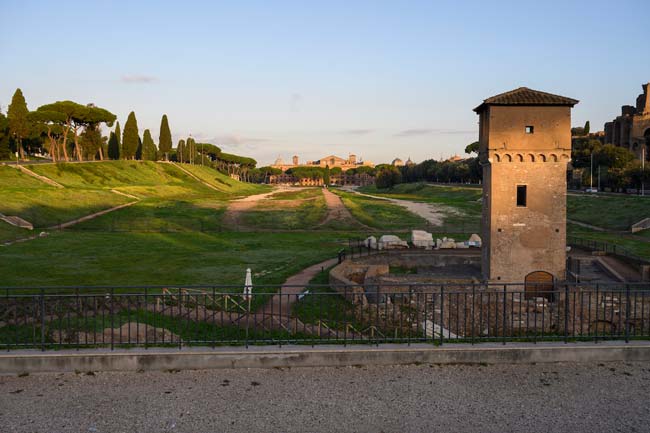
Rome’s chariot race track was already an established feature in Paul’s day.

Romans is Paul’s longest letter (just beating 1 Corinthians to the punch). It’s worth noting that this is why it comes first in the New Testament: Paul’s letters are organised in order of decreasing length. The Sunday lectionary contains readings from all its chapters except 2 and 3, so we need to spend a bit of time on it.

The number of readings reflects both its length, and the way it has been thought of, especially since the Reformation, as the most important of Paul’s letters, and a kind of compendium of his thought. Despite that long tradition, most people nowadays go at least part way to accepting that it is a response to specific circumstances, just like Paul’s other letters. It is written for a particular situation, not as a timeless treatise of theology. Different scholars give more or less weight to a whole range of different reasons, so I am going simply to outline my own speculation, which I think helps make sense of the letter’s content.

Towards the end of Romans, there is a very long list of greetings.1 It includes a greeting to Prisca and Aquila (Rom 16:3), whose role as co-workers I mentioned in this introductory post. It shows something of the international networking of the church, that Paul, who had never visited Rome, knows, or knows of, so many people in the church there. He is, in part, appealing to a network of relationships that he hopes will recommend his reliability to those who do not know him.

Nonetheless, he works harder than usual at developing a careful argument for his hearers. He knows it is a church in which he has no particular claim to authority. He wants a secure base in Rome, from which to launch his mission to Spain (Rom 15:24-25). The problem he faces is that the church in Rome is caught up in the controversies around the relationships of Jew and Gentile that are so much of a problem for Paul’s mission, and which give Paul a bad reputation in some Jewish Christian circles.

According to Acts, Priscilla and Aquila had been among those Jews who were expelled from Rome by the emperor Claudius (Acts 18:2). Clearly the edict has lapsed, and they have been able to return home. According to the Roman historian Suetonius, Claudius expelled the Jews because they were causing civil unrest “at the instigation of Chrestus”.2 Many scholars see this as a mishearing of Christus – Christ, and conjecture that the kind of disturbances that Acts narrates between followers of Jesus (Jew and Gentile) and other Jews, were also happening very early on at Rome, right under Caesar’s nose.

If this conflict was so bad to lead to an expulsion of the key Jewish players, it’s unlikely all is sweetness and light less than a couple of decades later. It is therefore unsurprising that a great deal of Romans is concerned with the relationships between Jew and Gentile. In fact, Paul seems to have situations of civic unrest, even violence, very much on his mind.

Do not repay anyone evil for evil, but take thought for what is noble in the sight of all. If it is possible, so far as it depends on you, live peaceably with all. Beloved, never avenge yourselves, but leave room for the wrath of God; for it is written, “Vengeance is mine, I will repay, says the Lord. (Rom 12:17-19 NRSV)

And a little bit later:

For rulers are not a terror to good conduct, but to bad. Do you wish to have no fear of the authority? Then do what is good, and you will receive its approval;  for it is God’s servant for your good. But if you do what is wrong, you should be afraid, for the authority does not bear the sword in vain! It is the servant of God to execute wrath on the wrongdoer. (Rom 13:3-4 NRSV)

Far from this being general ethics, I suggest it is very specific advice that the Roman Christians should not take the law into their own hands. Imagine a reconstruction that goes something like this.

The Roman Christians are generally (like most of the Roman Jews) relatively poor. The only house church mentioned at Rome is the one meeting in the house of the higher status home-owning businesspeople Prisca and Aquila. Others might have to hire some kind of venue, or possibly be dependent on the generosity of a wealthy patron. What if one or two of those wealthy patrons were so-called god-fearers, like the centurion mentioned in Luke 7, who built the local synagogue? Or like Cornelius, who “gave alms generously to the people” (Acts 10:2)? Such Gentiles are portrayed as particularly open to the Jesus movement.

Now imagine that quarrels had broken out between, on the one hand Gentile and Jewish believers in Jesus, and on the other, traditional Jewish Torah-keepers. They argued bitterly over the use of a building supplied, or meeting-place paid for, so generously by a Gentile patron. Those quarrels lead to the Jewish contingent being expelled from the city, and therefore from the building they used as a synagogue or meeting place.

What would they find when they return? A largely Gentile church using it, perhaps with the patron also having converted. It’s unlikely they would have accepted this meekly. The possibility of fresh riots and outbreaks of violence must have been very real, and on both sides of the argument, Christian and Jew. No wonder Paul has to sternly rebuke them, and urge them not to seek vengeance. No wonder he has to remind them that that sort of bad behaviour will call down the wrath of the state.

This is the setting in which he addresses the church: a city in which there is bitter division between Jews and Greeks – as Paul often calls all non-Jews. This is the situation in which he sets out his understanding of how his mixed Jewish-Greek Christian mission is a fulfilment of God’s calling of the Jewish people. Unlike his other letters, he writes this one to a church he has not founded, and therefore offers a much more carefully constructed argument seeking to persuade people who might not readily accept his authority. More than many readings in the lectionary, those from Romans need to be seen very much as part of the larger whole.

In the next post I will explore the arguments he uses.

Notes

  1. In the interests of transparency, I should note that there is some evidence that there may have been some early editions of Romans that lacked chapter 16 (and possibly 15 as well). The general view, however, is that these chapters are part of Paul’s original letter. Any shortened version may have been about producing a more general edition of the letter for second century churches which didn’t need all these personal greetings.

  2. Life of Claudius, 25.4 (An old translation is available online: http://penelope.uchicago.edu/Thayer/E/Roman/Texts/Suetonius/12Caesars/Claudius*.html

A radical faith in a faithful Messiah: some themes in Paul’s letters

In the previous post, I looked at some of the general issues involved in reading Paul’s letters. In today’s blog, I want to explore a couple of key themes. There are core ideas which crop up repeatedly in Paul’s thinking; but the specific ways he develops them belong to the different contexts of each individual letter.

One idea which crops up in a number of contexts is usually called “justification by faith”. Since some people suggest this is Paul’s main, only, or central theme, we need to spend a little bit of time looking at it here, while saving many other themes for individual letters. It’s probably also worth repeating my previously given health warning: other views of Paul are available, and here we enter one of the more controversial (and occasionally rather bad-tempered) areas of both modern scholarship and church-dividing doctrine.

Statue of St Paul in St Paul outside the Walls, Rome. Paul is commonly represented with a sword as a metaphor for the Word of God. This church is the traditional site of his burial.

Justification by faith was a key plank in the way Martin Luther interpreted Paul at the beginning of the Protestant Reformation. In Luther’s view, this was about how people could get to heaven, and he opposed it to the piety of the mediaeval church. In a nutshell, mediaeval Christians were shaped by participating in worship, pious works, almsgiving, penances, indulgences, and the good deeds of the saints. This created an (ecclesiastically very profitable) economy of salvation which was intended to help people make their earthly pilgrimage towards God, making up for their lapses and bad behaviour in purgatory, and helped along by the prayers of the faithful and the merits of Christ and the saints.

Luther cut through this economy, and the papal purse strings with it, by a simple insistence that faith – perhaps better “trust” – in Christ as having died for him (me, you, everyone) was all that was needed. When he did this, he mentally and literally translated Paul’s language of “works of the Law” into meaning the general “good works” mediaeval Christianity encouraged people to practice.

In doing so, he certainly captured two of Paul’s most important ideas. First, that trust in Christ is central to the Christian life, and second, that Christ’s crucifixion is central to how God transforms this world destined for death into the new reality of a creation restored to eternal life. On the downside, he made the Jews into examples of everything Christians shouldn’t be, and gave later German anti-Semitism some of its most forceful impetus.

In developing his contrast between faith and works, and gospel and law, he also slightly skewed what I want to suggest is Paul’s primary contrast, which is between Christ and Torah. For Paul, this goes back at least to the experience that Luke tells us happened on the road to Damascus. The Torah, as Paul read it in his youth, does not allow for the possibility of a crucified Messiah. It teaches (as we saw when looking at Deuteronomy) that there are two ways: the way of life and the way of death. Its instruction guides the people of God in the way of life. It promises blessing on the way of life, and threatens a curse on the way of death. And, as Paul notes when writing to the Galatians, it specifically states that anyone who is hanged upon a tree1 is cursed (Gal 3:13, quoting Deut 21:23). This is no doubt one of the main reasons why Paul persecutes the early Christians. They are (in his view before his conversion) making the law out to be a liar by saying God has blessed Jesus, when the law says quite clearly that Jesus is cursed.2

When Paul has his experience of Jesus, which he insists is an encounter with the risen Jesus as valid as any of the post-Easter appearances,3 he discovers for himself that, far from being cursed by God, Jesus is vindicated by God; far from being dead, he has been raised to life. Paul, as a good Pharisee, understood resurrection as the culmination of the kingdom of God for all Israel and the vindication of God’s people.4 Now he understands it as what has happened to and with Jesus; God has vindicated Jesus and declared him a truthful teacher, a faithful servant and a righteous son. From this experience, Paul develops a multifaceted contrast between Torah and Christ.

One of the principal contrasts is between two different ways of faithfulness. Torah taught one way of being faithful to God. It involved obedience to the commands of the law; this helped mark out a pure people, and gave them the appropriate means of reconciling oneself to God through the sacrificial system. Following the Maccabean crisis,5 the things that particularly marked out the purity of the people among the nations were the food-laws (especially eating pork), circumcision, and the keeping of the Sabbath. It’s therefore not surprising that these became a particular focus for some of Paul’s conflicts.

Jesus, his whole life and death, offers an alternative pattern of what faithfulness to God looks like. At its core is his willingness to embrace the ultimate impurity of a cursed death, so that he might bring the outsider, the sinner, the cursed, into the life of God. This is the vision, poetically summarised in the hymn-like section of Philippians,6 which drives Paul into the Gentile world. He casts aside his previous Pharisaic emphasis on purity, to embrace the profane world with Christ’s love. As Christ was faithful even to death on a cross, so Christians are called to follow him, so that they also may be justified – i.e. found to be on God’s side – by imitating the faithfulness of Jesus. This is why Paul can conclude his most extended argument of the theme of justification, the letter to the Romans, with the pithy ethical conclusion: “Welcome one another, therefore, just as Christ has welcomed you, for the glory of God.” (Rom 15:7).

There is one other general point worth making in this introductory section on Paul’s letters. An unfortunate picture has grown of Paul as a misogynist. There are certainly some passages which can be read in ways which now look decidedly unaffirming of women, but that was generally true of the whole of Graeco-Roman culture, in which women lived out their lives under the authority of a male relative.

However, in both Acts and Paul’s letters we see him treat the husband and wife team Priscilla (also called Prisca) and Aquila as colleagues, and interestingly it is usually Priscilla who is named first. He calls Phoebe the deacon his patron (which implies a social superior).7 His long list of friends in Rome includes many women, one of whom, Junia, he refers to as an “outstanding apostle.”8 When he writes to the Corinthians, he does indeed say some very confused and confusing things about head-coverings, but this is part of setting out how women should pray and prophesy in public worship.9

More interestingly, earlier in the letter, setting out his teaching on marriage, he follows what might be thought of as conventional patriarchal teaching (“the wife does not have authority over her own body, but the husband does”) with a rather more radical and counter-cultural egalitarianism (“likewise the husband does not have authority over his own body, but the wife does”).10 We might feel uncomfortable with both halves of Paul’s equation today, with our deeply rooted commitment to individuals having rights over their own body rather than another’s. However, this remains a fascinating example of Paul being more radically egalitarian than he is normally assumed to be.

There are other passages we could point to, but perhaps that is enough to show something of Paul’s radicalism and complexity, while remembering that he is still a man of his time. Sometimes our translations can be so good, that we forget the ideas being expressed in our modern words may mean something rather different in the culture of the first-century Mediterranean.11 Expecting Paul to be woke and judging him where he is not is simply an anachronism. He needs to be read against the horizon of his own day.

Notes

  1. In one of Peter’s speeches in Acts, the phrase “hanging on a tree” is also used as a way of referring to the crucifixion of Jesus (Acts 5:30).

  2. This is, I think, part of what Paul is getting at in 1 Corinthians 12:3 – “So I want to make it clear to you that no one says, “Jesus is cursed!” when speaking by God’s Spirit, and no one can say, “Jesus is Lord,” except by the Holy Spirit.” (Common English Bible) The Law, which only knows the pre-resurrection reality, says there’s a curse on Jesus, the Spirit, gift of resurrection life, says Jesus is God’s vindicated Messiah – the one with God’s own name of “Lord”.

  3. Though he also seems to be aware that there was something very different about it as well: the description he uses for his experience is not so much “born again”, but “like a miscarriage” (1 Cor 15:8)

  4. See the discussion about Jesus, the Pharisees and the kingdom of God in the section on Matthew’s gospel.

  5. See the discussion of the books of the Maccabees in this post.

  6. In so far as a single short passage offers a summary of Paul’s gospel, Philippians 2:6-11 is as good a contender as any for the role.

  7. The references are Romans 16:3, 16:1.

  8. Romans 16:7 (Jerusalem Bible). Despite the name being obviously feminine, some scribes had turned this into an unknown male name, Junias, and other interpreters, like the translators of the King James Bible, has decided Paul must mean she was “of note among the apostles”. Sometimes Paul gets the blame for what his interpreters do with his writings.

  9. 1 Corinthians 11:2-16. There are good reasons (including the argument of chapter 11 about what women should wear while speaking in church) for thinking the later verses, 1 Cor 14:34-35, which command women to be silent in church, are a later addition by a scribe to Paul’s letter. In some copies of the letter they occur in a different place. This often means something a scribe originally jotted in the margin has found its way into the main text.

  10. 1 Cor 7:4. The section as a whole is longer, but continues to balance the rights of both.

  11. This introduction is already too long! But I shall say more to help locate Paul in his social context in the next posts on Romans and 1 Corinthians especially.

Paul: a health warning

I expect this to be the first of two posts introducing Paul. In the second, I want to take a look at some of his characteristic themes, but today, I want to renew a health warning I have occasionally mentioned elsewhere. Everything you read here is just my opinion. I hope my opinions are well-grounded in the text and the world it was written in. I hope they provide good, illuminating and helpful ways of reading the text. I hope they help you read it, for yourself, and to others, with fresh understanding. But there are always other opinions available.

This variety of views is nowhere more obvious than it is with regard to Paul’s writings. One of the earliest comments we have on them comes in the Second Letter of Peter:

So also our beloved brother Paul wrote to you according to the wisdom given him, speaking of this as he does in all his letters. There are some things in them hard to understand, which the ignorant and unstable twist to their own destruction, as they do the other scriptures. (2 Peter 3:15-16)

El Greco’s early 17th century painting of St Paul. Via Wikimedia Commons

For most of the last 500 years, there has been a dominant tradition of reading Paul that owed a huge amount to Martin Luther, John Calvin and the Protestant Reformation. It assumed Paul was a Protestant, and often forgot he was a Jew. Most of the critical scholarship that developed in the modern period did so in a Protestant context, and this favoured the letters which stressed the themes of the Reformation, above all the letter to the Romans. Other views were very much in the minority.

In the last quarter of the twentieth century, this consensus was pretty much shattered, although the view still has many fans. But with the breaking of that consensus, just about every possible interpretation of Paul is now seriously offered in scholarly argument, even if only by a handful of people. That means that for most of us, understanding Paul has become something of a minefield.

You won’t have to go far to find someone who will passionately disagree with some or even much of what I say. Nonetheless, I hope, bearing that health warning in mind, what I say here will commend itself to you by helping make sense of Paul’s writings, not least the passages that we read in the lectionary. I will only occasionally draw your attention to these controversies, and concentrate much more on Paul’s own themes.

Gaining an understanding of Paul does matter for those who read it in public worship. The lectionary has more selections from Paul than from any other biblical author, even if we only count the letters nearly everyone agrees that he wrote. That may be a new idea to you, that some people think Paul is not the author of all the books that bear his name, or you may have come across it before. It’s one we need to look at briefly.

Which letters did Paul write? Well, in one sense, none of them. He composed letters, yes, but the actual writing was left to others: fellow workers doing the work of scribes, and possibly amateur scribes at that. Typically, we can think of Paul dictating his letters, and occasionally scrawling something on the parchment or papyrus. At the end of his most frantic and angry letter to the Galatians he adds: “See what large letters I make when I am writing in my own hand” (Gal 6:11). They are large letters in contrast to the neater writing of a practiced scribe, perhaps a professional writer, perhaps a slave in a Christian household. Sometimes the scribe adds his own line, as Tertius does at the end of Romans (Rom 16:22).

For most scholars, there are differences in style between Paul’s letters. Some are much more noticeable than others. (These are often harder to spot in translation: we might notice whether something sounds more like the King James Version or the Message, but translations often make the biblical authors sound quite like each other!) These differences of style raise questions whether they are due to a scribe having more say in the content, Paul addressing a different audience and tailoring his style accordingly, or someone else writing in Paul’s name (with or without his authority to do so). In particular, many scholars have serious doubts about whether Paul wrote the letters to Timothy and Titus.

Collectively but somewhat misleadingly these are referred to as the Pastoral Epistles. They are much more Organisational Letters in which Paul (the presumed author) tells Timothy or Titus (the presumed recipient) how to run the church. In these there is a very different style, but also a very different context, as letters written (on the surface at least) by an apostle able to give orders to a junior colleague, and expect them to be carried out. In these letters, he does not need to persuade a church to go along with him. For many people, the style (and some content) is simply too different to be Paul. Others are still persuaded Paul is (in at least some sense) the authorial mind behind the text.

Most of Paul’s letters, however, are written as letters to specific churches, addressing particular problems. We are in the frustrating position of someone overhearing a phone call: we can hear one end of the conversation, but we have no idea what the other party is saying. We have to make guesses about the situation, the problem, and the question being asked from the comments and answers Paul makes. There’s plenty of room to misunderstand details there.

Because Paul is always responding off the cuff to particular contexts, his thoughts spread across the different letters. He will emphasise one theme here, and another there. He never sits down to organise his thoughts into a neat theological system. Unfortunately, perhaps, there have been an awful lot of people who have wanted to do it for him, and they have often turned his occasional arguments into a comprehensive theology.

This is another reason for the arguments about which letters Paul himself wrote. There’s always a risk that people construct their own picture of Paul’s theology, and then chuck out the letters that don’t fit very well. For rather a long time, one of the arguments used against Paul’s authorship of Ephesians, or the Pastoral Letters, was that they were too churchy. That, however, says more about the dominance of post-Enlightenment German Protestantism in modern scholarship, than it does about Paul.

Paul is often landed with a bad reputation. That may say as much about his interpreters and their prejudices as it does about Paul. The perceived prejudices mask someone who was sometimes quite revolutionary in his attitudes to Graeco-Roman society. I find him a fascinating character: not always one I’d have felt very comfortable to be with, but someone who was and is endlessly stimulating. In my next post, I’ll take a look at some key ideas.

Welcome to Lection and Liturgy

Welcome to Lection and Liturgy. I have backed up to this site a series of posts making a guide to the whole of the Christian Bible, aimed p...

Some frequently read posts