In my previous post,
I offered a picture of the context at Rome which causes Paul to write
this letter. It is written to a city in which divisions between Jews and
Greeks focussed on claims about Jesus have previously boiled over, and
may be heating up again. I noted that more than in most letters, with
Romans you need a grasp of the overall argument to see the meaning of
any individual reading. Today I offer that kind of outline of how I read
this letter. There are others.
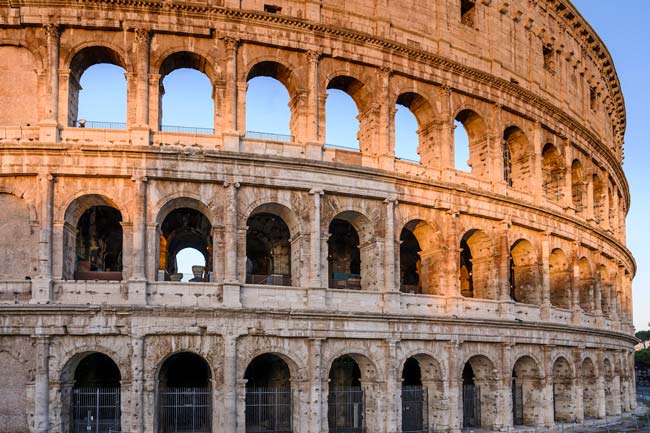 |
| The Colosseum, built after Paul’s day, reminds us how much violence was a feature of the Roman Empire |
Paul’s first three chapters, after an opening greeting, step straight
into this. Paul initially takes up and repeats the common criticisms
Jews made of the pagan world, and then he echoes some not atypical Roman
anti-Semitic attacks on Jews. Both are shown to deserve the criticism
the other dishes out, but Paul goes on to privilege the Jewish
scriptural tradition, not because it was given to the Jews, but because
it was given by God. God will be faithful even when God’s people are
not. In point of fact, the scripture reinforces the mutual criticism Jew
and Greek heap on each other, for it says “There is no-one righteous,
no, not one.” (Rom 3:10)1
From this rather dismal conclusion, that everybody is in the wrong,
Paul recounts God’s call to Abraham, and how Abraham was treated by God
as righteous, because he put his trust in God. The theme of chapter four
is that God treated Abraham as righteous before he was circumcised, and
therefore circumcision is not necessary. Abraham’s trust, that God
could give him new life (a son) even though his body was as good as dead
(being well past the age of reproduction) is paralleled to the
Christian trust in God for life, as the one who raises the dead Jesus.
Paul goes on in chapter five to contrast Jesus with Adam. The
biblical story reveals how things were changed for the whole human race
through the acts of one man, and so Paul argues that equally through the
acts of another man, the condition of the human race is changed again.
Yet the comparison is limited: the first man was judged for one single
sin. Since then countless sins have been committed, yet the
relationship-restoring gift of Jesus – a life faithfully obedient even
to death – is more than enough to overcome all sin.
If this is God’s gift to us, Paul goes on to say in chapter six, then
we need seriously to reciprocate by giving our lives to God. If God in
Christ has taken human death, the consequence of sin, to give us life,
then we must leave sin behind, and live our lives with the same
faithfulness that Christ has shown. Paul extends that in chapter seven
with a parable of everyman, or Adam. God’s commandment, God’s law, was
precisely the thing that made disobedience possible. If there is no law,
I can’t break it. Once I am taught morality, I can be tempted to do
wrong. What I need is a new kind of life, a new nature and not a new
law.
The death of Jesus is the death of our old humanity: the mortality
promised Adam as a punishment for his law-breaking is embraced by Jesus
in order to bring it to an end. In his resurrection, Jesus opens up a
new kind of life. That life, as Paul goes on to say in chapter eight, is
the life of the Spirit, and it is not just about the renewal of
humankind, but the liberation of all creation. If in his opening
chapter, Paul described a creation having gone wrong, turned away from
God, and into itself, in this closing chapter of his primary theological
argument, he looks forward to “the hope that the universe itself is to
be freed from the shackles of mortality and is to enter the glorious
liberty of the children of God” (Romans 8:21 REB).
In all of this, Paul has effectively put the law to one side. The
good things the law teaches are now enshrined for us in the example of
obedience given by Jesus: this is what faithfulness looks like. The bad
effect of the law, tempting us to disobedience, is now dealt with by
Christ, who has experienced the promised judicial punishment of the
human race, and has been acquitted on appeal by God, setting the human
race free. The law, therefore, has no continuing purpose. It can neither
function any longer as a barrier separating Jew from Greek, nor can any
Jew expect Greeks who believe in Jesus to keep its commandments. It
belongs to a past humanity that died with Jesus on the cross.
On the other hand, Paul is well aware that he runs a real risk that
the Greek Christians will feel themselves superior, certainly to
non-Jesus-believing Jews, and probably to Jewish Christians as well. In
chapters 9-11, he therefore tries to set out the ways in which the
Jewish people belong to God’s purposes, and are his chosen way of
getting from Adam and then Abraham, to Christ.
Paul himself is proud of being a Jew, but puts his trust not in his
ethnic and religious inheritance, but in the gift of God – in the Christ
to whom the Jewish scriptures have now led him. It is a a cause of
sadness for Paul that so few Jews seem to accept Jesus in place of Torah
as the model of faithfulness and the life-giving gift of God. Despite
this, Paul still wants to hold on to the overwhelming generosity of
God’s gift as being stronger than the human power to reject it. He draws
this section to a close affirming his faith in God’s love, his hope for
Jewish redemption, and his inability to plumb the depths of how exactly
God will work it all out.
From there he passes to the practical outworking of this new life,
and new set of relationships. We have already looked at the key plank of
avoiding violence and vengeance, as befits those who follow the
crucified Christ rather than a warrior Messiah. Paul elaborates some of
the key themes of Christian living, stressing the unity of the church,
and maintaining good relationships, with those outside, as well as
within the church. There are a number of echoes of Jesus’ words in this:
Paul is not ignorant of some of the teaching we find in the gospel. In
particular, where ethnic or religious traditions give people scruples
about eating certain sorts of food, it is very important to practice
generosity and welcome to those who hold different views.
It is clear from a number of his injunctions that the church in Rome
is (to pt it mildly) somewhat divided. Paul, however, has not given up
on his hope to be sent on his way to Spain by a church united behind
him. Rather than his practical need, it is the preceding lengthy
exposition of the gift of God, a generosity that comes precisely to
those who do not deserve it, which drives the ethical force. If we seek
to be faithful as Christ was faithful, we must treat one another with
the generosity God in Christ has shown to us. The thrust of the letter,
as well as the very practical guidance on sharing food together, is
summed up “in a word, accept one another as Christ accepted you, to the
glory of God” (Romans 15:7).2
Notes
This begins a string of quotations, mainly drawn from the
psalms, that roots Paul’s conclusion in the scriptures he and those he’s
arguing with share.
- The REB, which I mainly follow here, has
“accepted us” rather than “accepted you”. Some manuscripts have “us” and
some “you”. (The words were probably identical in pronunciation by the
second century at the latest.) Most translations go with the
rhetorically rather more forceful “you”.


